
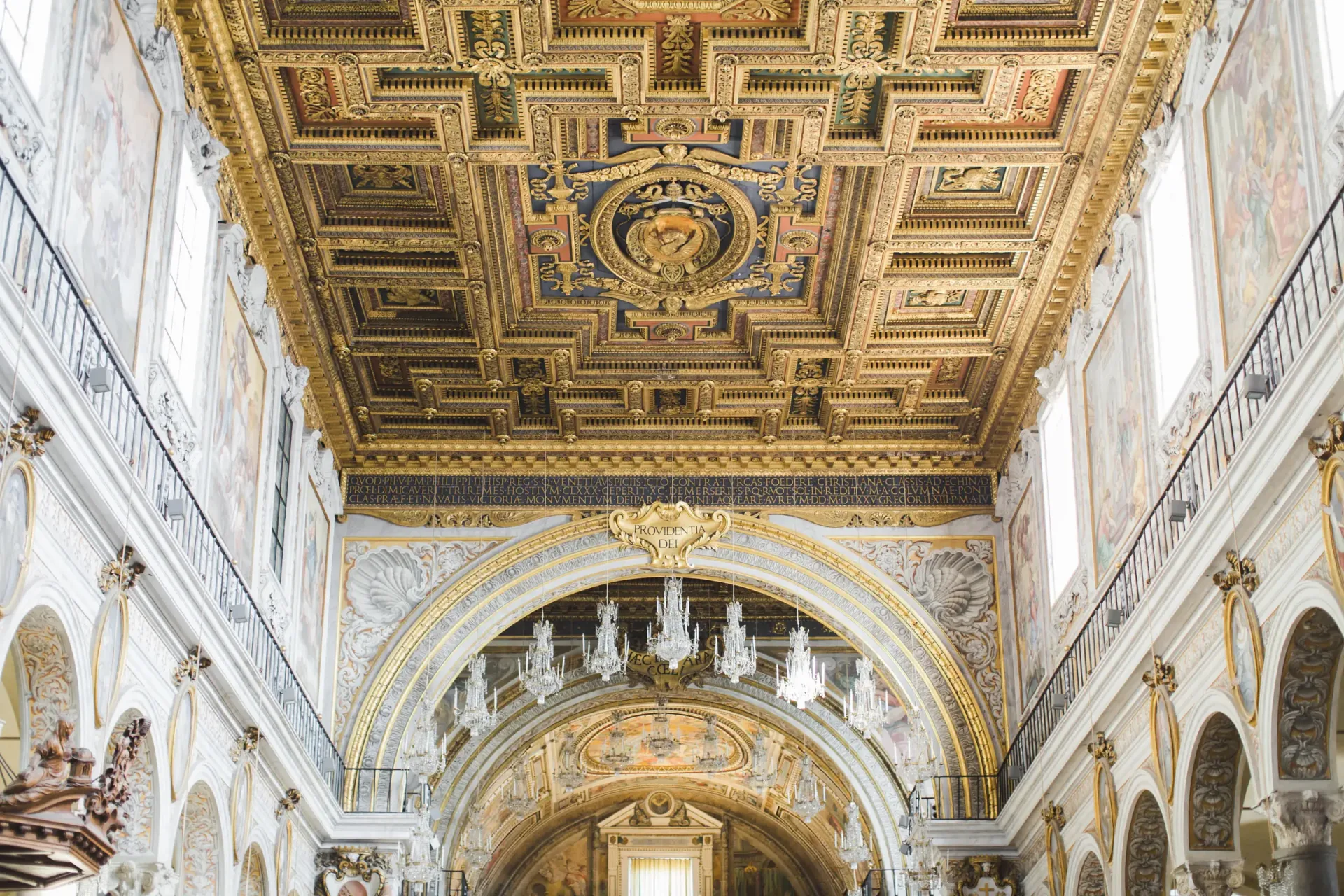
Two churches, two very different Roman wedding days
Choosing a church in Rome is not only about the most beautiful interior. For a destination wedding the church sets the rhythm of the whole day: where guests arrive, how far everyone travels afterwards, where the photographs happen, which musicians and flowers you can bring, and how naturally the ceremony becomes dinner.
Aracoeli or Trastevere
Two churches we know particularly well for international weddings give you two different versions of Rome. Santa Maria in Aracoeli is the monumental city: the Capitoline Hill, a grand basilica and a formal Roman ceremony. Santa Maria in Trastevere is the neighbourhood: a church that opens onto a living piazza, where the ceremony, the aperitivo and dinner feel like one continuous evening.
Neither requires you to be a parishioner. Both require the full Catholic file, prepared at home and approved through Rome, which we explain in our documents guide →
How we choose a church with you
We ask the practical questions first. Where is it in relation to your hotel and your dinner? What ceremony times are free on your date? Can you bring your own photographer, florist and musicians? Will it feel full with your guest list, or empty? Will the day stay connected to the city afterwards, or will everyone need another transfer? A church can look perfect in photographs and still make a difficult day, which is why we choose it together with the rest of the plan.
Santa Maria in Aracoeli
The monumental Roman ceremony: a basilica on the Capitoline Hill, and the historic centre at your feet for the photographs afterwards.
Aracoeli sits above Piazza Venezia in one of the most recognisable places in Rome. It feels formal, historic and unmistakably Roman, which is why it suits couples who want the ceremony itself to be one of the great moments of the day. Afterwards, the couple is already in the heart of the city: portraits around the Capitoline, Piazza Venezia, the Pantheon or Piazza Navona, then on to the reception.
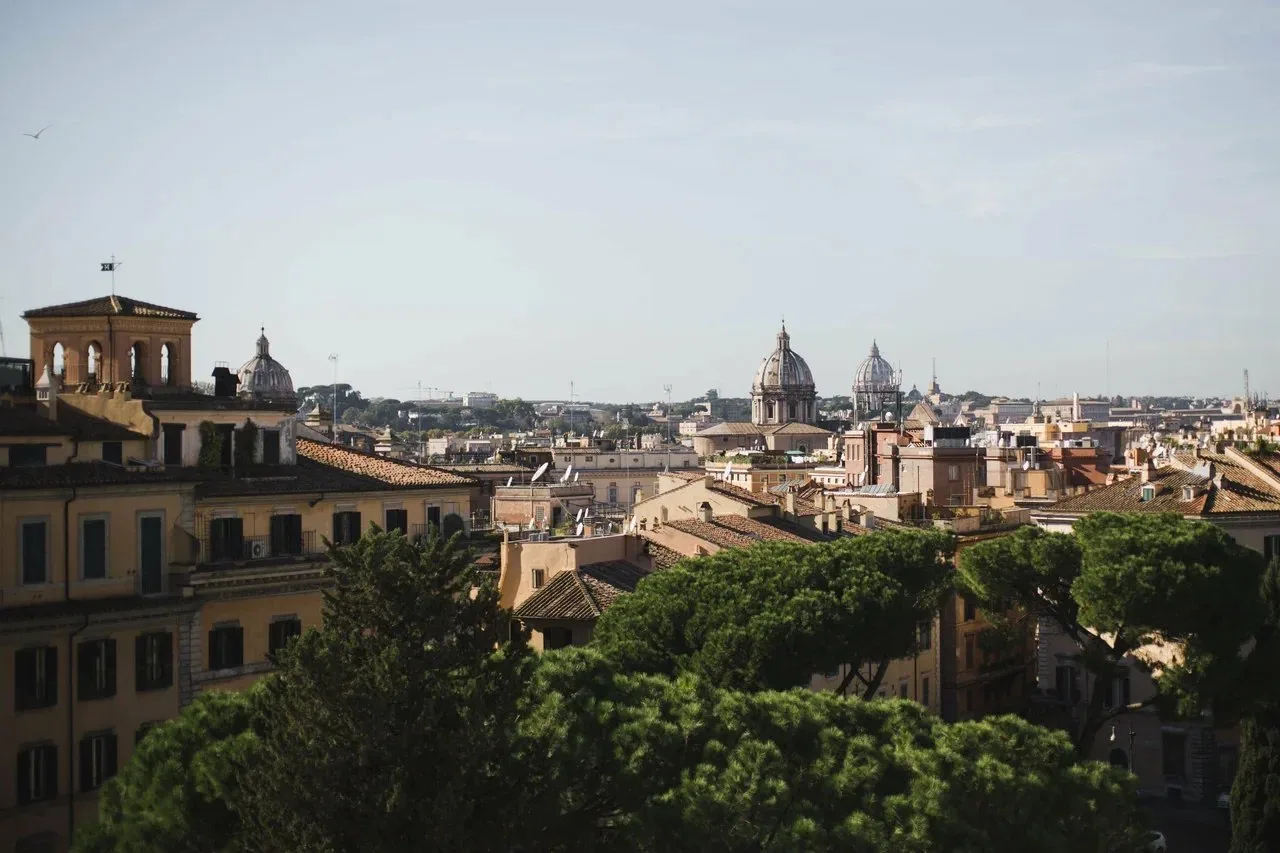
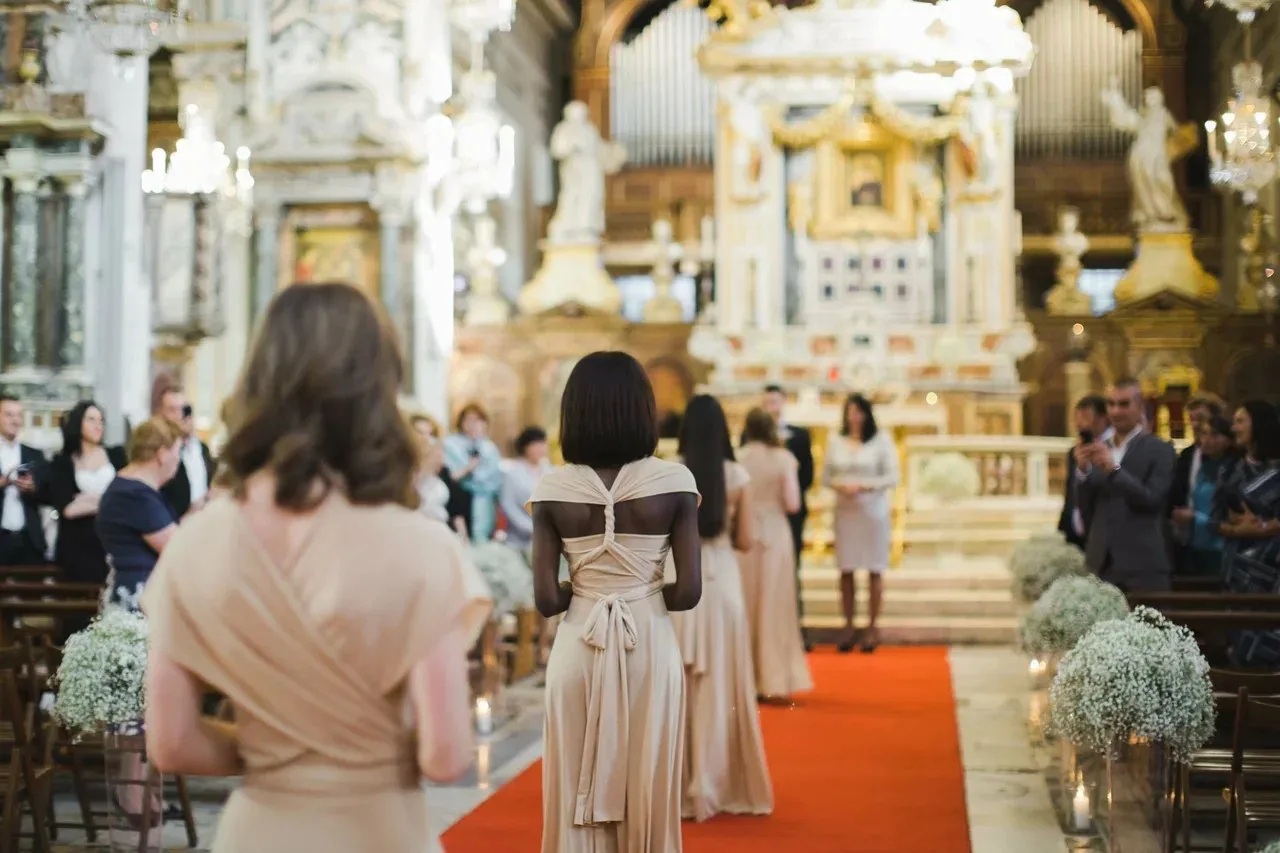
The church itself. Aracoeli stands on the highest point of the Capitoline Hill, on the ruins of the Temple of Juno Moneta. Its name comes from a legend that a sibyl told the emperor Augustus here of the coming of the Son of God: haec est ara filii Dei, this is the altar of the Son of God. Franciscan friars have cared for it for centuries, and in the Middle Ages it was the civic heart of Rome, where Petrarch was crowned poet in 1341. The marble staircase was built in 1348 as a thank-offering for the end of the plague, and Romans once climbed it on their knees to ask for a favour, a marriage among them. Inside are frescoes by Pinturicchio in the Bufalini Chapel, works by Benozzo Gozzoli, a Cosmatesque floor and a tomb carved by Donatello. (Source: Turismo Roma.)
For couples from abroad. You do not need to be local parishioners. Besides the full Catholic file, Aracoeli asks your home parish priest to sign a short acknowledgement that they know you will marry at the Basilica. It does not replace the file; it simply confirms the choice of church.
The celebrant is agreed with the Basilica in advance. It may be a priest connected with the church, or you may ask whether a priest you know can take part. We check this for your date rather than assume.
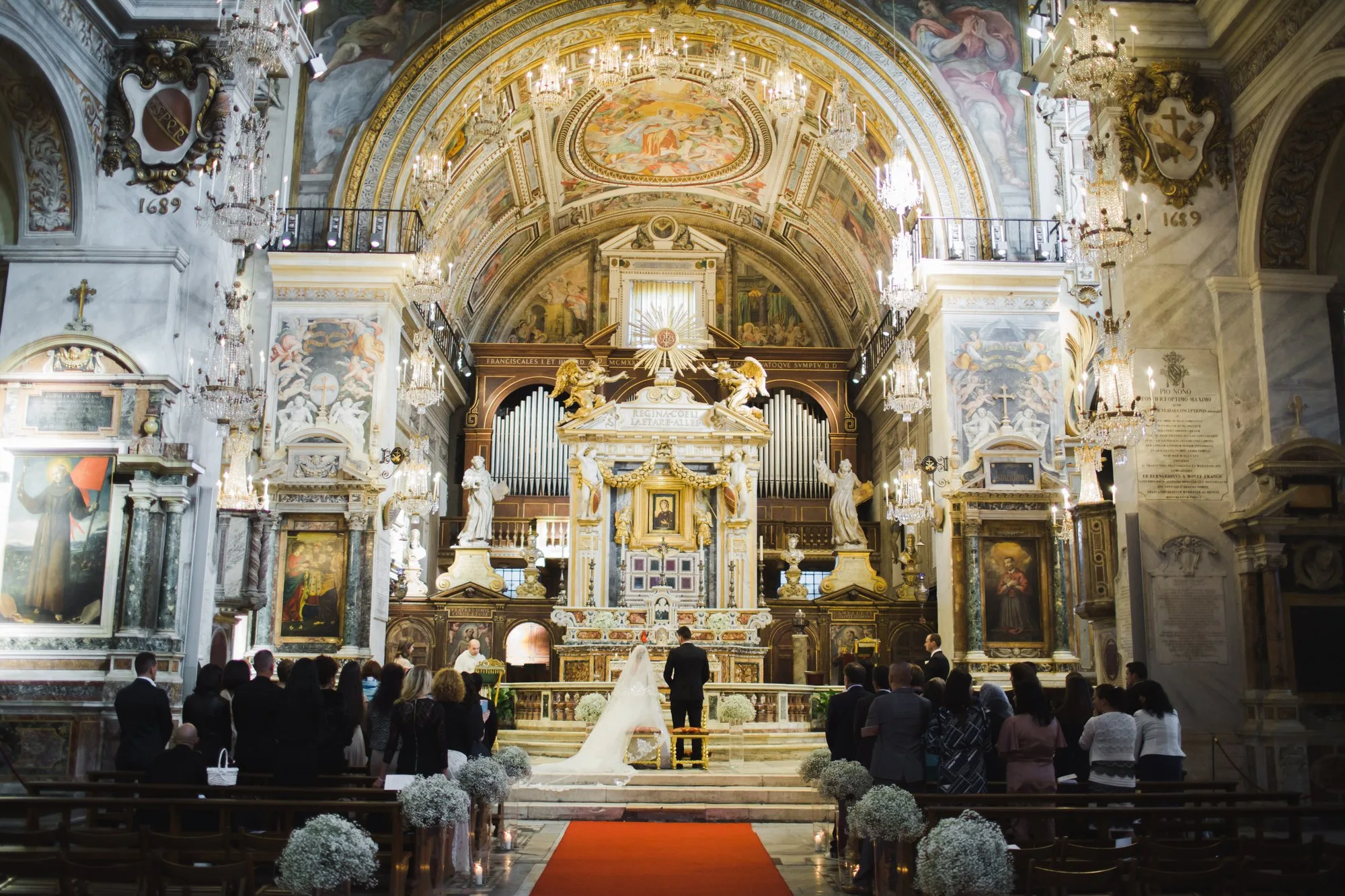
Music is arranged through the church's own contacts: organ, singers, and for couples who want something lighter, it is worth asking about violin, voice or a small ensemble. The repertoire is agreed in advance.
Photography is possible, provided the photographer respects the liturgy. We brief them beforehand, so nobody is working out where to stand once the ceremony has begun.
The steps. The great staircase up to Aracoeli has 124 marble steps. They make the photograph, and they are not for everyone. For older guests and anyone with reduced mobility we plan the arrival through the side entrance from the Capitoline square instead, and the church can authorise two cars to enter the limited-traffic zone and drive right up to Piazza del Campidoglio. We use them for the couple and for the guests who need them most, so the climb is a choice, not a condition.
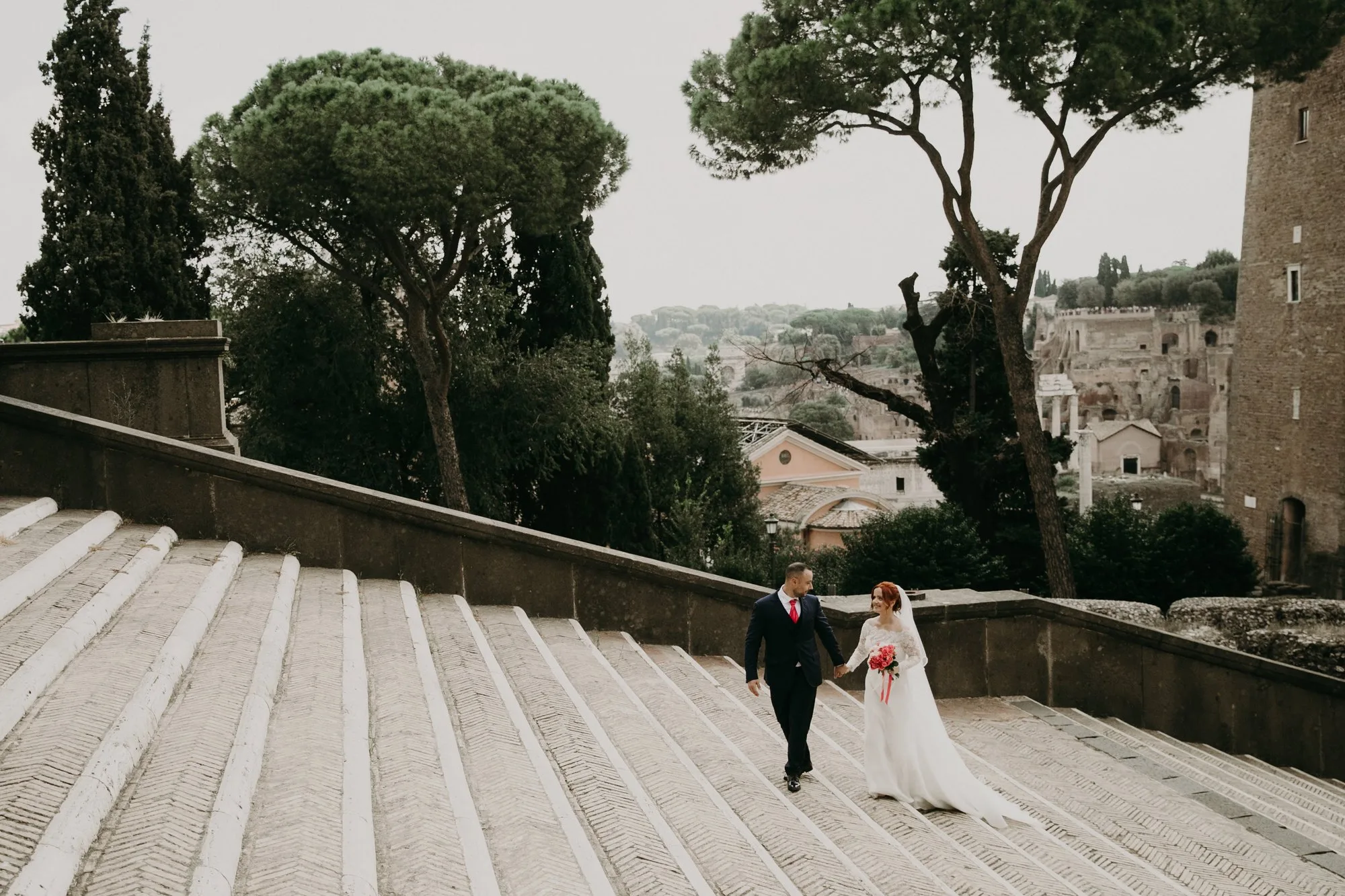
A day around Aracoeli: preparations at a central hotel, a private car to the Capitoline, the ceremony, family photographs outside, portraits through the historic centre, then aperitivo and dinner on a terrace or in a historic hotel. The mood is formal, architectural and entirely Roman.
Santa Maria in Trastevere
The intimate one: twelfth-century mosaics, doors that open straight onto a living piazza, and dinner a short walk away.
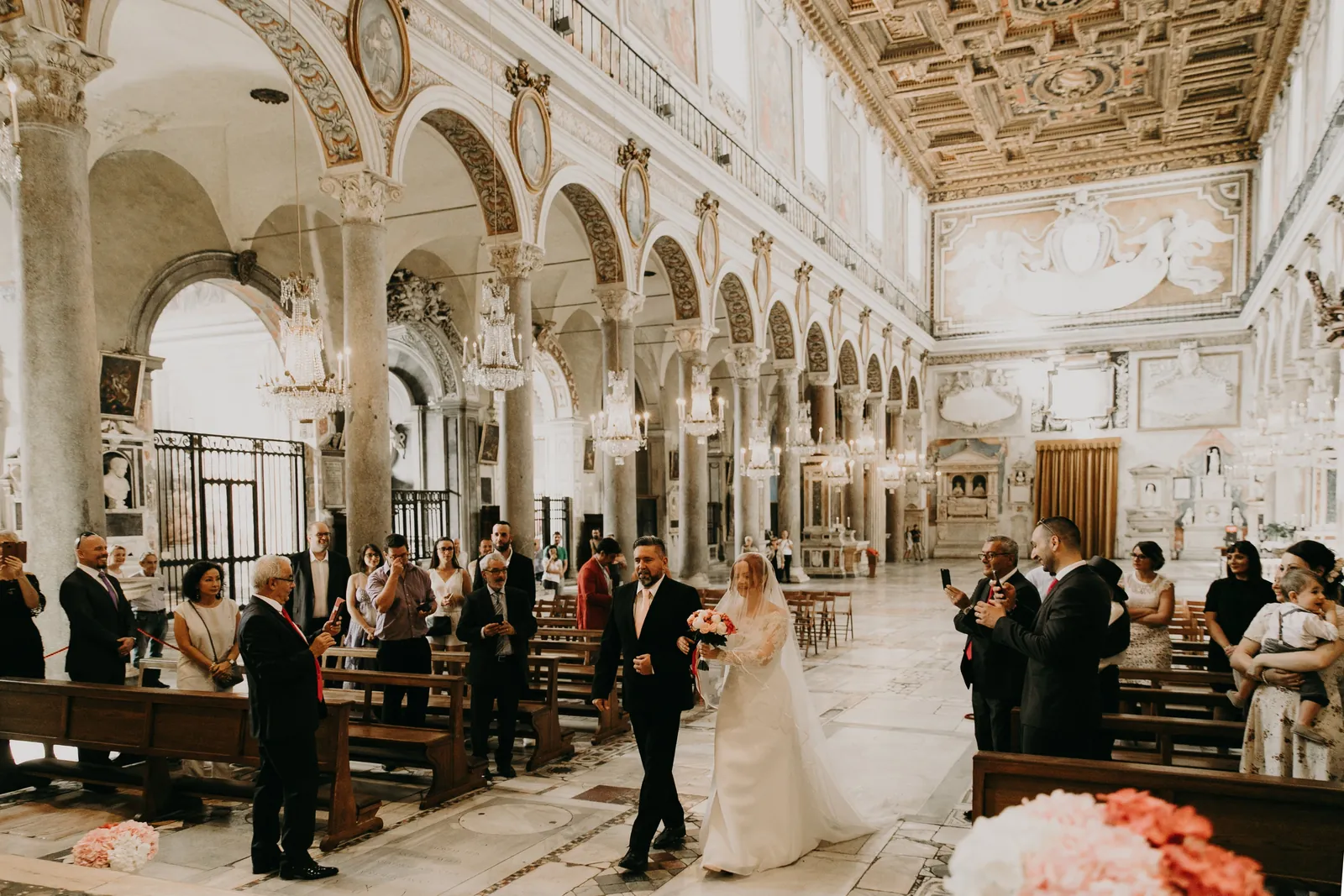
Santa Maria in Trastevere puts the wedding inside one of Rome's most atmospheric neighbourhoods. When the ceremony ends, you step out into the piazza, the cafés and the narrow streets, and the day continues from there. For couples who want the wedding to feel like one Roman evening rather than a sequence of venues, it is hard to beat, and we particularly like it for smaller weddings.
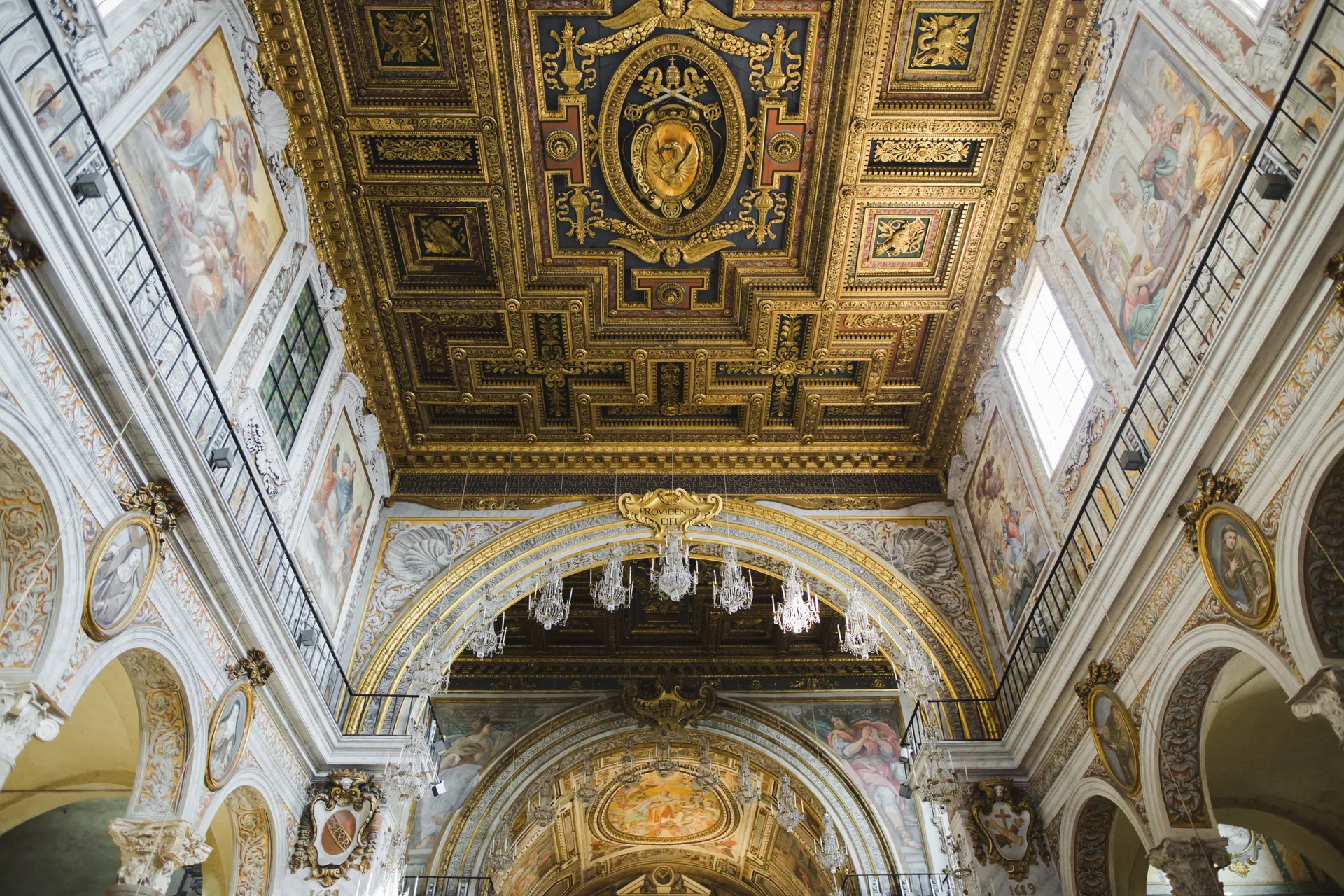
The church itself. Santa Maria in Trastevere is probably the first place in Rome where Christians worshipped officially. Legend gives its foundation to Pope Callixtus I in the third century, and it was completed in 340. Much of what you see today dates from the twelfth century, when Innocent II rebuilt it: the bell tower, and the apse mosaic of around 1140 in which the pope holds a model of the church. Below it, Pietro Cavallini's mosaics of the life of the Virgin date from 1291. The twenty-two ancient granite columns probably came from the Baths of Caracalla, and the gilded coffered ceiling was designed by Domenichino in 1617. It is a church dedicated to Mary, and you marry beneath her story told in gold. (Source: Turismo Roma.)
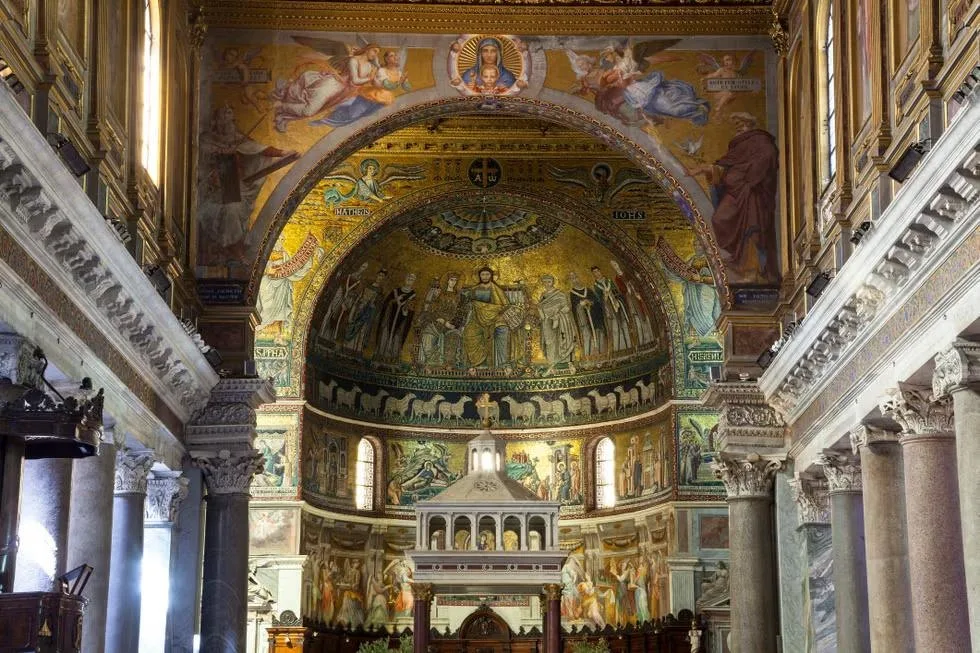
Ceremony times. At the time of writing, weddings are celebrated Monday to Saturday at 10:15, 12:00 or 15:00, and on Sundays and religious holidays at 15:00 only. We reconfirm for your date. We usually prefer the afternoon, so the ceremony flows into photographs, aperitivo and dinner without a long gap.
For couples from abroad. The Basilica accepts reservations and follows the Diocese of Rome marriage procedure, so you do not need to be parishioners. Modello XIV must reach the church before the wedding.
Music. You may bring your own musicians, and the Basilica can provide a keyboard. Its own organist and singers can be arranged through the church's music contact. The repertoire is agreed in advance.
Photographers of your choice are allowed, as long as they do not disturb the celebration. We brief them on the church before the day.
Flowers are welcome but restrained by rule: nothing in the chancel or around the altar beyond a small altar arrangement; no pins, tape or nails on the pews; rice, petals and confetti only outside in the square, never inside or under the portico. Your florist agrees the set-up time with the church in advance. In practice the Basilica needs very little: its mosaics do the work.
It is not a private venue. The church stays open during the wedding and its doors cannot be closed, though tourist visits are suspended during the celebration. For many couples that is part of the beauty: you marry in a living Roman basilica, not a building borrowed for the afternoon.
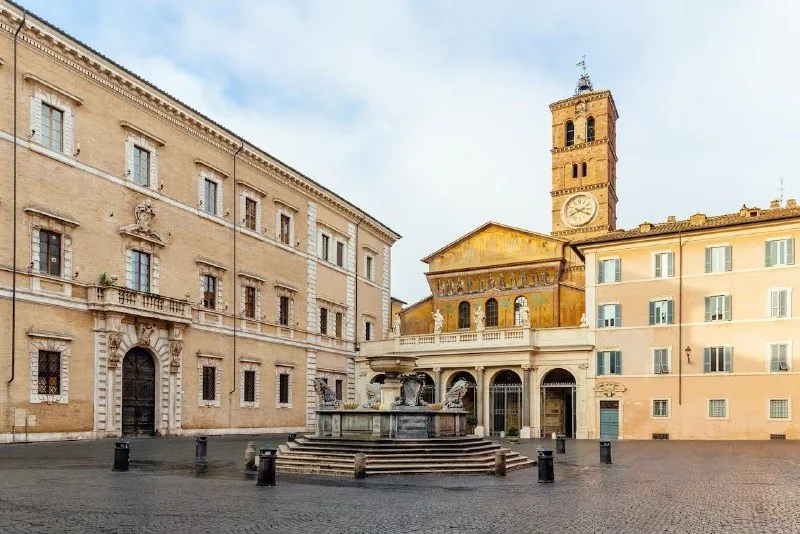
Arrival. The piazza is pedestrian and the area sits inside a limited-traffic zone. Cars carrying the couple, elderly guests or guests with reduced mobility have normally been able to approach for drop-off, but there is no church parking. We plan everyone else's arrival on foot, by taxi or by arranged transport, especially when dinner is outside Trastevere.
A day around Trastevere: preparations at a hotel or apartment nearby, the ceremony, family photographs in the piazza, portraits through the surrounding streets while guests walk to aperitivo, and dinner a short walk away, in the cloister and orangery of Donna Camilla Savelli, a Borromini convent on Via Garibaldi. See the venue and its budget → The mood is relaxed, social and of the neighbourhood.
Which one?
| Santa Maria in Aracoeli | Santa Maria in Trastevere | |
|---|---|---|
| The feeling | Formal, monumental, ceremonial | Intimate, social, of the neighbourhood |
| Best for | A grand ceremony as the centre of the day | A smaller wedding that flows into the evening |
| After the ceremony | Portraits through the historic centre | Photographs in the piazza, a walk to aperitivo |
| Reception that suits it | A central hotel, palazzo or terrace | Donna Camilla Savelli, a Borromini convent a few minutes' walk away, from €60,000 for thirty guests Donna Camilla Savelli → |
| One thing to plan | The 124 steps: a side entrance and two cars allowed up to the Capitoline square | Arrival inside the limited-traffic zone |
Neither is better. They are different days, and the right one depends on the wedding you are picturing.
What we check before we recommend a church
The date and time, whether it accepts international couples, priest arrangements, music, photography and flower rules, the church contribution, accessibility and drop-off, guest transport, the distance to the reception, and how the ceremony sits in the day. These are the details that decide whether the wedding feels easy for you and your guests.
From our weddings in these churches
At Aracoeli, the steps are for the photograph, not for everyone. The 124 marble steps are the most beautiful arrival in Rome, so the couple and the younger guests usually take them. Older guests and anyone who finds stairs difficult arrive by car at the side entrance on the Capitoline square, using the two cars the church authorises inside the limited-traffic zone, and walk in on the level.
Trastevere is at its best with a smaller guest list. Its charm is the intimacy of the church and the life of the piazza outside, and a large, formal wedding works against both. For a big guest list we usually point couples to Aracoeli.
Every florist gets the church's rules before the day. Both basilicas limit what can go near the altar and how anything is fixed to the pews, so we send the rules to the florist in advance and agree the set-up time with the church.
Our experience
Marina was married in a Catholic church in Sicily in 2016 and Katerina on Lake Como, so we know this process from the couple's side as well as the planner's. We speak to the churches in Italian and check each one's current rules before we recommend it, then connect the ceremony to everything around it: the priest, music, photography, flowers, transport, timing and dinner.
Questions couples ask
Ask your ownCan foreigners marry in a Catholic church in Rome?
Yes, once the Catholic file is complete through your home parish and diocese.
Can we choose Aracoeli if we live abroad?
Yes, with the full file and your parish priest's signed acknowledgement of the choice.
Can we marry at Santa Maria in Trastevere if we are not parishioners?
Yes, subject to the Diocese of Rome procedure and the Basilica's availability.
Can we bring our own priest?
It depends on the church and must be agreed in advance. We check it as soon as you have chosen.
Will the church be closed to tourists?
At Santa Maria in Trastevere the church stays open, but tourist visits are suspended during the ceremony. Other churches have their own rules.
Which is better for a small wedding?
We lean towards Santa Maria in Trastevere for intimacy, and towards Aracoeli for a formal, monumental ceremony.
Planning a Catholic wedding in Rome?
Marina, who founded WOWITALY, answers every inquiry herself. The first video call is with Katerina, it costs nothing, and it is not a sales call.
The church is one of the first decisions we make together, because it shapes almost everything else. Start with our Catholic wedding guide → · See the documents step by step →
hello@wowitaly-weddings.com · +39 334 840 2086